A business owner looking for 4,000 square feet in Hialeah this summer saw the same headline everyone else did: Miami-Dade industrial vacancy climbing, more space on the market, tenants finally getting some leverage. He called on three listings. Two were already under contract by the time he got a callback. The third wanted a personal guarantee and six months upfront, the kind of terms landlords ask for when they know they don't need to negotiate.
That gap between the headline and the phone call is the whole story. Miami-Dade's countywide industrial vacancy rate rose to 7.7 percent in the second quarter of 2026, according to Colliers, up 60 basis points from the prior quarter. If you're shopping for a 200,000-square-foot distribution box, that number is real and it's working in your favor. If you're shopping for a small-bay unit in Hialeah, Medley, or the airport-adjacent submarkets, that number describes a market you don't live in.
The vacancy that's rising isn't the vacancy you're renting
The county's vacancy increase came almost entirely from new supply hitting the market, not from tenants leaving. Colliers reported 769,100 square feet of new industrial space delivered in the second quarter, while businesses still leased roughly 3 million square feet during the same period, bringing first-half leasing activity to 7.4 million square feet. Net absorption actually turned positive at 782,677 square feet, reversing three straight quarters of occupancy losses. Asking rents kept climbing too, up to $17.19 per square foot on a triple-net basis, 1.5 percent higher than a year earlier.
Read those numbers together and the story isn't softening demand. It's new big-box product landing in the market faster than tenants can absorb it, while rents hold because the space that's actually functional, well-located, and the right size for how people use it hasn't gotten any easier to find. A vacancy uptick and a rent increase happening in the same quarter is not a contradiction. It's two different markets being reported as one number.
Where the vacancy actually lives
The clearest picture of that split shows up at the submarket level. Using first-quarter 2026 data compiled by Serhant Florida Commercial Group, the divergence between Miami-Dade's tightest infill corridors and its looser inland ones is stark:
| Submarket | Vacancy | Weighted Net Rent | Under Construction |
|---|---|---|---|
| Hialeah | 3.0% | $17.09/SF | None |
| Airport East and Downtown | 2.9% | $15.24/SF | None |
| Northwest Dade | 9.8% | $15.59/SF | 653,434 SF |
Hialeah's vacancy ran at less than half the 6.5 percent countywide rate reported for that same quarter, and separate broker data from Agora Real Estate Group described Hialeah's vacancy dipping below 2 percent for last-mile and small-bay users specifically. The two figures don't match exactly, brokers define submarket boundaries and sample sets differently, but they point in the same direction. Northwest Dade, by contrast, has 653,434 square feet under construction and a vacancy rate more than three times Hialeah's, which is exactly why it's dragging the countywide average up while doing nothing to the price of a Hialeah unit.
Why small-bay stays tight when the county doesn't
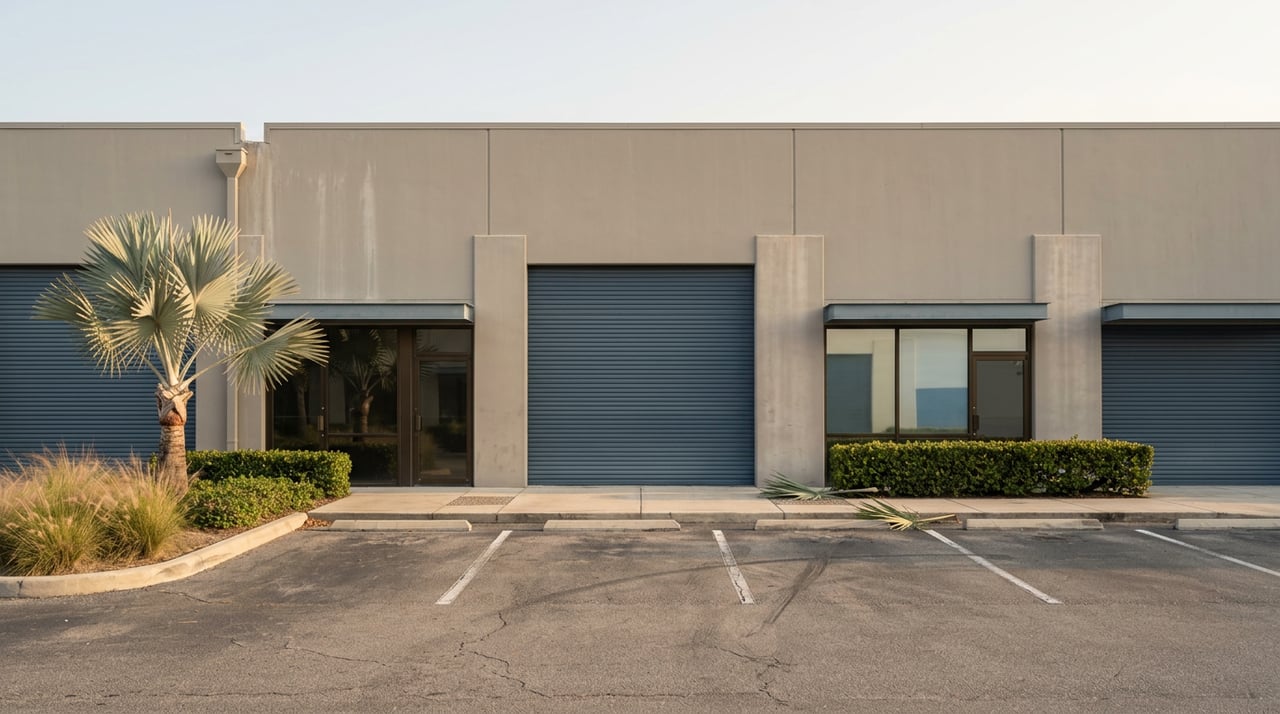
The mechanism is straightforward once you see it: developers build spec big-box because the economics work at scale. Nobody builds spec small-bay. A 5,000-square-foot flex unit doesn't pencil the same way a 200,000-square-foot distribution box does, so the supply of small-bay product is whatever already exists, and that supply doesn't grow just because the county issues more permits somewhere else.
That scarcity is showing up in how investors are pricing infill product. Terreno Realty's purchase of Hialeah Gardens Commerce Center for $56.3 million was the largest sale of the second quarter, followed by TA Realty's $47.6 million acquisition of Webster Business Park. Two separate truck stop sales, totaling $51 million and $20 million, closed the same quarter, a signal that capital is chasing anything tied to Miami-Dade's transportation and logistics infrastructure, not just headline distribution assets. South Florida industrial cap rates averaged 6.3 percent in the first quarter of 2026, and Colliers noted that pricing has held steady even as borrowing costs rose, which suggests buyers and sellers are settling into agreement on what infill product is actually worth rather than waiting each other out.
Meanwhile the big-box side of the market kept moving too. CompletePet Florida signed the quarter's largest lease at 190,351 square feet in Building C of Beacon Logistics Park. That's not a market losing tenants. It's a market where demand for scale product and demand for scarce infill product are behaving like two separate economies that happen to share a county line.
The airport is about to tighten one corridor further
There's a second force working against anyone hoping Airport West loosens up: Miami International Airport itself is buying land around its own perimeter. The airport's aviation real estate team is pursuing industrial parcels adjacent to MIA as part of a $14 billion, multi-year modernization program, and the need isn't for new terminals. Airport officials told the county's Aviation and Seaport Committee in July that they face an estimated 240-acre shortage just for contractor parking, equipment storage, and construction staging during the buildout, according to Miami Today's reporting on the committee meeting.
Aviation Director Ralph Cutié put it plainly to the committee: "Our real estate team is doing a phenomenal job trying to acquire as much land as we can." He described the land shortage as "one of the biggest concerns" facing the modernization timeline, which includes the new Concourse K, already under construction and targeted for completion in fall 2029.
That buying has already touched real transactions. Miami-Dade County paid $19.2 million for Duty Free Americas' 68,000-square-foot warehouse at 1800 Northwest 70th Avenue this spring, intended for construction staging before eventual repositioning to commercial use, according to The Real Deal's coverage of the deal. It's the latest in a pattern: the county paid $17 million for a 3.4-acre site from Prologis and $45 million for a 198,500-square-foot industrial complex in prior years. Every one of those purchases pulls a parcel out of the private industrial market permanently. If you're underwriting anything in Airport West or Doral on the assumption that land supply stays where it is, that assumption is already out of date.
What this means if you're underwriting a deal right now
The county-level vacancy rate is a real number and it belongs in your model, but only if your target asset actually competes with the big-box product driving it. A few things worth checking before you anchor a decision to the headline:
- If your space need is under 10,000 square feet, the countywide vacancy rate tells you almost nothing about your actual competition. Ask for submarket-level vacancy and construction pipeline data specific to Hialeah, Medley, or wherever you're looking, not the county average.
- Rising vacancy paired with rising rent is a signal the market is bifurcating by asset quality and size, not softening broadly. Don't read a headline increase as blanket negotiating leverage.
- If you're targeting Airport West or Doral, factor in that a public buyer with a $14 billion mandate is actively competing for the same land you are, and that competitor doesn't need financing approval the way a private developer does.
- Off-market small-bay product in infill corridors is getting harder to find precisely because it's not being built. If sourcing off-market deals is part of your strategy, that strategy needs to start earlier than it did two years ago.
You can read more on how these corridors are shifting in our companion piece on how Miami-Dade's warehouse corridors are evolving, and if you're closer to signing than sourcing, our practical guide to leasing flex warehouse space in Miami-Dade walks through the terms worth negotiating in a market like this one.
A few questions worth asking before you act
Does a countywide vacancy increase mean rents will come down soon? Not necessarily. Rents rose to $17.19 per square foot in the same quarter vacancy climbed, because the new supply landing in the market is concentrated in specific corridors, not spread evenly across all product types and locations.
Is Hialeah's tight vacancy likely to loosen if construction picks up elsewhere? Unlikely in the near term. Hialeah had no new construction underway as of the first quarter of 2026, and the economics that keep developers from building spec small-bay product haven't changed.
Does MIA's land buying affect all of Miami-Dade's industrial market? No, it's concentrated around the airport's perimeter and is most relevant to buyers and tenants specifically targeting Airport West and Doral. Corridors farther from MIA aren't affected by this particular pressure.
If you're weighing a small-bay purchase, a flex lease, or land near one of these corridors, the countywide number is a starting point, not an answer. Irene Dakota works these submarkets directly, sourcing and underwriting industrial and flex deals across Miami-Dade with the corridor-level data that actually drives a good decision. Let's Connect.